State Values in International Policy
 |
| Image Credit: Newsweek |
The relationship between beliefs and interests in shaping
the actions of rational state actors has been the subject of debate for many
international relations theorists. Keohane and Goldstein contend in their
article on state interests that:
“Ideas
influence policy when the principled or causal beliefs they embody provide road
maps that increase actors’ clarity about goals or ends-means relationship, when
they affect outcomes of strategic situations in which there is no unique
equilibrium, and when they become embedded in political institutions.”[1]
Goldstein and Keohane’s argument is predicated on the idea
that states adopt sets of values which help them clarify goals, providing
subjective criteria for weighing policy decisions. Over time, those values are
institutionalized as norms and customs for state behavior. The authors contend
that values will come to form a framework for states as they evaluate their
national interests as it relates to actions in the international realm. But
within this context, how can we define a states’ values? More importantly, can
a causal relationship be drawn between publicly expressed state values and
policy decisions, or do divergent policy decisions indicate that a state holds
values that are different from the beliefs that it publicly espouses?

I would contend that what states claim to believe and how
they act are not always causally linked, and that the most appropriate method
for determining a states’ values is to examine how their policy actions reflect
perceived interests, tying those interests to subjective value judgments made
by states. To illustrate this assessment, I will briefly evaluate the U.S. claims
to value human rights within the context of our international policies since
the Vietnam War.
Historical US Policy
on Human Rights
“Human rights is the soul of our
foreign policy. And I say this with assurance, because human rights is the soul
of our sense of nationhood.”[2]
-
President Jimmy Carter
The U.S. established a formal human rights policy in 1970,
and dedicated a State Department bureau to handle human rights concerns in
international affairs.[3]
Jimmy Carter in 1977 outlined a strong U.S. commitment to human rights and
respect for sovereignty, seeking to shape a foreign policy which “changed the
fundamental nature of American relations with the third world while still
protecting essential American interests.”[4],[5]
Carter felt that the U.S. had overreacted to Soviet expansion during the cold
war, and that it had compromised our support for human rights.[6]
Reagan similarly assessed that it was in the U.S. interests to encourage
democratization, and encouraged reform in El Salvador, Chile, South Korea, the Philippines,
and Taiwan.[7]
George H.W. Bush was a committed realist, abandoning this
strong stance on human rights, discouraging nationalism in Ukraine, maintaining
close relations with China following the massacre at Tiananmen Square, and
failing to prevent human rights violations by Saddam Hussein in Iraq.[8] Clinton
vacillated on human rights, basing decisions on perceived national interest-
removing human rights rules and trading actively with China while increasing the
trade embargo against Cuba.[9] Each
of these presidents made unequivocal commitments to value and support human
rights, but often acted based on calculated rational self-interest.
Modern Positions on
Human Rights
“Let us rededicate ourselves to the advancement of human
rights and freedoms for all, and pledge always to live by the ideals we promote
to the world."[10]
-
President Barack Obama
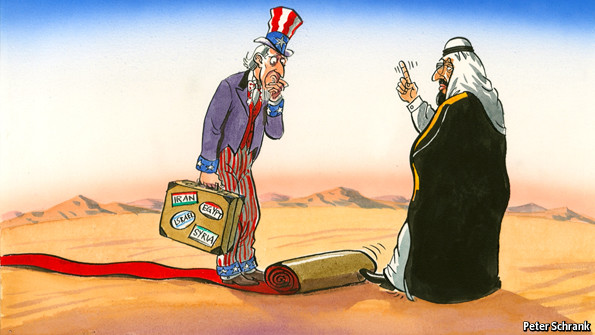
The U.S. relationship with Saudi Arabia has been strained by
generations of presidents who have sought to balance fundamental economic
interests and raw power calculations with a fundamental distaste for the
autocratic, and frequently repressive, regime.
 |
| Image Source: Economist |
The Economist
summarizes the interests at play in this relationship:
“The equation was simple: America
would provide security, the Saudis oil. Those shared interests, cemented by a
mutual loathing of communism (and a more recently shared hatred of Iran’s Shia
theocracy and of al-Qaeda terrorists), papered over inevitable differences
between a hermetic autocracy, backed by fearsomely puritanical Wahhabist
clerics, and an ebullient, proselytising democracy…In the midst of turmoil
across the region, and with the threat of jihadist terrorism ever-present,
America still relies heavily on the Saudis as the leading local policeman.”[11]
Saudi disregard for international human rights norms is increasingly
forcing the U.S. to pit value based interests of promoting democracy and human
rights with economic and security interests. Within this context, Keohane and
Goldstein might argue that our values should provide the roadmap for defining
our goals and ends-means relationship with Saudi Arabia.
Human rights issues will come to a head this month, as the
Saudi autocracy prepares to punish Saudi blogger Raif Badawi with the second installment
of a total of 1000 lashes, earned for egregiously “insulting Islam,” or perhaps
simply insulting powerful Sunni clerics.[12] One
wonder’s little why Badawi’s lawyer was then rewarded with 15 years
imprisonment for "undermining the regime and officials," ''inciting
public opinion" and "insulting the judiciary.”[13]
Even the UN High Commissioner on Human Rights, Arab Muslim Prince
Zeid Ra’ad Zeid al-Hussein of Jordan, called the flogging “cruel and unusual
punishment” and torture.[14]
The U.S. response has been characteristically timid, with the U.S. Secretary of
State John Kerry calling for “many avenues of legitimate review for the judgment.”[15]
The Way Forward
Determining which values best suit the U.S. interests will
continue to be a challenge, especially when new diplomatic crisis emerge. Mark
P. Lagon, writing for The Council on Foreign Relations, concluded that: “A
broad-minded view is that more consistency in promoting human rights would in
fact better serve U.S. credibility and national interests. Presidencies past
too often sacrificed human rights for other foreign policy objectives.”[16]
[1] Goldstein,
Judith, and Robert O. Keohane. "Ideas and foreign policy: an analytical
framework." Ideas and foreign policy: Beliefs, institutions, and political
change (1993): 1
[2] Jimmy
Carter, Remarks at a White House Meeting Commemorating the 30th Anniversary of
the Universal Declaration of Human Rights 's Signing, December 6, 1978
(Accessed online, 21 January 2015 http://www.presidency.ucsb.edu/ws/?pid=30264)
[3] Mark
P. Lagon, “Promoting Human Rights: Is U.S. Consistency Desirable or Possible?”,
The Council on Foreign Relations,
October 2011 (Accessed online, 21 January 2015 http://www.cfr.org/human-rights/promoting-human-rights-us-consistency-desirable-possible/p26228
)
[4] Ibid,
par 4
[5] Schmitz,
David F., and Vanessa Walker. "Jimmy Carter and the foreign policy of
human rights: The development of a post–cold war foreign policy."
Diplomatic History 28, no. 1 (2004): 113
[6] Mark
P. Lagon, “Promoting Human Rights: Is U.S. Consistency Desirable or Possible?”,
The Council on Foreign Relations,
October 2011 (Accessed online, 21 January 2015 http://www.cfr.org/human-rights/promoting-human-rights-us-consistency-desirable-possible/p26228
)
[7]
Ibid., par 5
[8] Ibid.
par 6
[9] McCormick,
James. American Foreign Policy and
Process. Cengage Learning, 2013, p. 331
[10] President-Elect
Barack Obama, Statement of President-elect Obama on Human Rights Day, December
10th, 2008 (Accessed online, 21 January 2015 http://change.gov/newsroom/entry/statement_of_president_elect_obama_on_human_rights_day/)
[11] “Awkward
Relations,” The Economist, March 29th,
2014 (Accessed online, 21 January 2015 http://www.economist.com/news/middle-east-and-africa/21599767-american-president-and-saudi-king-will-have-unusually-edgy)
[12] Corey
Charlton, “Saudi blogger sentenced to 1,000 lashes,” Daily Mail, 22 January 2015 (Accessed online, 22 January 2015 http://www.dailymail.co.uk/news/article-2921597/Saudi-king-halts-flogging-blogger-facing-1-000-lashes-Middle-Eastern-country-accused-outrageous-inhumanity.html)
[13] Dominique
Mosbergen, “Saudi Blogger Sentenced To 1,000 Lashes May Not Withstand 2nd Round
Of Flogging, Says Wife,” The Huffington
Post, 15 January 2015 (Accessed online, 21 January 2015 http://www.huffingtonpost.com/2015/01/15/raif-badawi-saudi-blogger-flogging_n_6478520.html?cps=gravity_2684_8260730021359095942
)
[14]
Rick Gladstone, “Saudi Arabia: U.N. Denounces Flogging of Blogger,” The New
York Times, 15 January 2015 (Accessed online, 21 January 2015 http://www.nytimes.com/2015/01/16/world/middleeast/saudi-arabia-un-denounces-flogging-of-blogger.html?_r=0
[15] JAY
SOLOMON andnFELICIA SCHWARTZ, “U.S. Rebukes Saudis for Sentencing Blogger to
1,000 Lashes,” Wall Street Journal, http://www.wsj.com/articles/u-s-rebukes-saudis-for-lashing-sentence-1420764258
[16] Mark
P. Lagon, “Promoting Human Rights: Is U.S. Consistency Desirable or Possible?”,
The Council on Foreign Relations,
October 2011 (Accessed online, 21 January 2015 http://www.cfr.org/human-rights/promoting-human-rights-us-consistency-desirable-possible/p26228
)

No comments:
Post a Comment