Saturday, January 31, 2015

War is Normal

“Mankind must put an end to war before war puts an end to mankind.”[1]
-          John F. Kennedy

Source: Huffington Post
International relations theorist Kenneth M. Waltz voiced a strong reflection on the state of international affairs, contending that:

“The recurrence of war is explained by the structure of the international system. Theorists explain what historians know: War is normal. Any given war is explained not by looking at the structure of the international-political system but by looking at the particularities within it: the situations, the characters, and the interactions of states.”[2]

John Lennon’s pipe dream provides the antithesis for the international system, imagining a future with no countries, no religion, no possessions, no greed, and no hunger.[3] Absent this vision, neorealist theory concludes simply that wars are business as usual.

Examining Ongoing Conflicts with a Neorealist Lens

Russia’s Aggression in Ukraine

Source: NBC News
The Russian Invasion of Ukraine is best understood within the context of Vladimir Putin’s fundamental outlook on regional security and opportunism. John Mearsheimer writes that “Putin and his compatriots have been thinking and acting according to realist dictates, whereas their Western counterparts have been adhering to liberal ideas about international politics.”[4]

Kenneth Waltz explains how these principles impact Russian policy in Eastern Europe, reiterating that: “where a number of states are in balance, the skillful foreign policy of a forward power is designed to gain an advantage without antagonizing other states and frightening them into united action. At times in modern Europe, the benefits of possible gains have seemed to outweigh the risks of likely losses.”[5]

The Russian calculation that it can make strategic power and territorial gains in Eastern Europe without inciting an armed response from the U.S.  is grounded in the neorealist assessment of bipolar relationships. Waltz writes that: “The separation of their interests reduces the occasions for dispute and permits them, if they wish, to leave each other alone even though each defines its security interests largely in terms of the other.”[6]

U.S. Invasion of Iraq

Source: PBS
Neorealists view the world as predominately anarchic, forcing states to provide for their own security. Waltz writes that: “States continue to coexist in an anarchic order. Self-help is the principle of action in such an order, and the most important way in which states must help themselves is by providing for their own security.”[7]

Within this context, many U.S. security experts and commentators felt that preemptive action against Saddam Hussein and Iraq was in the west’s security interests. John Bolton, former U.S. ambassador to the United Nations, wrote in 2013 that “The fact is that Saddam Hussein, with or without actual WMD, was a strategic threat to peace and security in the Middle East and globally.”[8]

Ambassador Bolton and others reflect a key neorealist tenant that “overreaction is the lesser evil because at worst it costs only money for unnecessary arms and possibly the fighting of limited wars.”[9]

Lessons from Neorealist Theory

The neorealist explanations for two major conflicts initiated by the world powers reflects its fundamental approach to the international system: “States in an anarchic order must provide for their own security, and threats or seeming threats to their security abound.”[10]


[1] Statement of President John F. Kennedy to the UN General Assembly, September 25, 1961 (Accessed online 31 January 2015, http://www.state.gov/p/io/potusunga/207241.htm
[2] Waltz, Kenneth N. "The origins of war in neorealist theory." Journal of Interdisciplinary History (1988): 615-628.
[3] John Lennon, “Imagine”, 11 October 1971
[4] Michael McFaul, “Faulty Powers: Who Started the Ukraine Crisis?” Foreign Affairs, December 2014 (Accessed online 31 January 2015, http://www.foreignaffairs.com/articles/142260/michael-mcfaul-stephen-sestanovich-john-j-mearsheimer/faulty-powers)
[5] Waltz, Kenneth N. "The origins of war in neorealist theory." Journal of Interdisciplinary History (1988): 622
[6] Ibid., 624
[7] Ibid., 624
[8] John Bolton, “Overthrowing Saddam Hussein was the right move,” The Guardian, 26 February 2013 (Accessed online 31 January 2015 http://www.theguardian.com/commentisfree/2013/feb/26/iraq-war-was-justified)
[9] Waltz, Kenneth N. "The origins of war in neorealist theory." Journal of Interdisciplinary History (1988): 623
[10] Ibid., 619

Wednesday, January 28, 2015

Michelle's Lack of Headscarf

Yesterday, President and Mrs. Obama cut short their trip to India and attended the funeral of King Abdullah in Saudi Arabia.  While this trip was described by The White House as "apolitical," there have been some politics surrounding the fact that Michelle Obama did not wear a headscarf.  While at first this story seemed a little bit silly, I thought it was entertaining and an easy way to pass the time.  I am on a flight to Dallas right now and I find myself continuing to read article after article about how the reaction to this might be taken in Saudi Arabia; could this have an impact on US relations with the Saudis; could this even factor into the Iranian nuclear talks.  And as a Western woman, I find myself thinking about ideas and interests...and hair.

For those of you who may not have seen this story, here is the Washington Post's article on it: http://www.washingtonpost.com/blogs/worldviews/wp/2015/01/27/michelle-obama-forgoes-a-headscarf-and-sparks-a-backlash-in-saudi-arabia/.

So, as I have learned, Saudi Arabia has a history of relaxing the expectation of a headscarf for foreign guests, and it would seem that Michelle Obama was allowed to attend the funeral without one.  There were a number of other female foreign guests who were also present without a headscarf.

So, what are my ideas here?  What are US ideas, especially of women and our role in society?  I hold very strongly to the idea that women are equal members of our culture, job market, and political bodies.  It would seem that this is the belief of most Americans.  In fact, earlier this week during the President's trip to India, he spoke about India's gender inequality, pushing forward the American idea of women's rights.  "If nations really want to succeed in today's global economy, then they can't simply ignore the talents of half of their people," Mr. Obama said.[1]

As part of this idea, I believe that women should not be forced to hide in shame underneath a headscarf.  If a woman chooses to observe such a tradition as part of her religious beliefs, then I fully support her choice.  However, the oppression of women that has taken place by dictated attire goes against the idea of women's equality.  President Obama enforced that idea, speaking in India on Wednesday.  “Indian women have shown that they can succeed in every field  Every woman should be able to go about her day and be safe and be treated with the respect and dignity that she deserves.”[2]  I think a most basic respect for all people is being allowed to choose how you appear as you go about your day.

So, based on my ideas, I believe that Mrs. Obama should be allowed to wear whatever she wanted within an attempt to dress respectfully at King Abdullah's funeral.  But yet, seeing her beautiful hair uncovered, my first reaction was, "Just wear the scarf.  How hard is that?"  I was surprised at myself.  Women everywhere, of every culture, value hair as a very large portion of our outward expression of our gender and cultural identity.  So the headscarf has always bothered me.  Why should we have to hide who we are and celebrate something that is so identifying to the women we are?  And yet, my first thought was that Mrs. Obama should have just covered up to make thing simpler.

I started to break this down and wonder what could have inspired such an initial reaction when it seems to go against the ideas, values, and beliefs that I hold as a woman.  And I came to the realization that it's because I know the American interest in maintaining a strong and functional relationship with Saudi Arabia.  It is an interest that has been the main factor, I believe, in most American interaction with this state.  But, as Laffey and Weldes explain, ideas can be what motivates political interaction or policy decisions.  And to assume that these ideas are just secondary concerns or peripheral factors is shortsighted and does not account for all of the actions that are occurring.

In this case, I believe that Mrs. Obama made a statement by showing her hair.  She expressed the belief of the American women that we do not need to shy away from who we are.  To think that she didn't have a scarf or was incapable of getting one to wear for this last minute trip would be naive.  This had to be a decision that Mrs. Obama made.  And I, for one, am glad that this very important idea is what was voiced during this apolitical trip to Saudi Arabia.  I understand that this is not some major policy shift - it's not even a written expression of the First Lady's ideas.  But Michelle's visible hair does affirm her position and I am very proud to have had a first lady who stood by the ideas of the American women rather than allowing them to take a backseat to political interests.

1.


Tuesday, January 27, 2015

U.S.-Israeli Relations: A struggle between values and interests


(Image Credit: NBC News)


In keeping with the case study on Somali Piracy, I decided to identify another meaningful study for evaluating the role of values and interests in determining state behavior. One important international event that has been very contentious for the international community is the Israeli military operations against Gaza and the Palestinians to prevent rocket incursions. The United Nations report reviewing operations from June to August 2014 concluded that: “a “staggering” three-fourths (1,479) of a total of 2,158 Palestinian fatalities were civilians, of them over one-third (506) were children.”[1]

Image Source: ccun.org

Within this context, the United States was forced to choose between supporting and condemning a key U.S. ally in a contentious and volatile region. U.S. policy can be analyzed as a reflection of our perceived national values or as a calculation of interests in the region. Laffey and Weldes contend that values provide a lens or framework which shapes a state’s perception of its national interests.[2]

A values based analysis of U.S. policy should contend that the American commitment to human rights should dictate a strong diplomatic response to Israeli excesses. This approach would expect the U.S. to respond by bringing a resolution against Israel for using excessive force, similar to how the U.S. has addressed human rights violations in Bosnia or Sudan.

An interests based approach to U.S. policy decisions would contend that Israel is a key ally in the region, and responsible for keeping the peace and preventing an upsurge in terrorism. Israel requires assistance from the western world in combatting the threat posed by Islamic terrorists.

As we would expect, the U.S. chose to balance its values of human rights with what it perceives as key strategic interests in the region. The United States took a position somewhere in the middle between interests and values. In July, President Obama made a speech “"Israel has a right to defend itself against rocket and tunnel attacks from Hamas. Israel has already done significant damage to Hamas's terrorist infrastructure in Gaza... We have serious concerns about the rising number of Palestinian civilian deaths and the loss of Israeli lives. That is why it now has to be our focus and the focus of the international community to bring about a ceasefire that ends the fighting and can stop the deaths of innocent civilians, both in Gaza and in Israel."[3]

This case study illustrates how values and interests can be applied to evaluate policy decisions, providing insight into how a country defines and acts on its perceived interests.


[1] “Accountability for Israeli, Palestinian rights violations vital for peace – UN official,” The United Nations News Service, 22 September 2014 (Accessed online 27 January 2015) http://www.un.org/apps/news/story.asp?NewsID=48778#.VMhS_GjF-So
[2] Laffey, Mark, and Jutta Weldes. "Beyond belief: ideas and symbolic technologies in the study of international relations." European Journal of International Relations 3.2 (1997): 193-237.
[3] Ren Zhongxi, “Obama reiterates support for Israel,” Xinhua, 22 July 2014 (Accessed online 27 January 2015, http://english.cntv.cn/2014/07/22/ARTI1405987378520399.shtml) 

Sunday, January 25, 2015

An Interest-based Relationship: Is the U.S. Dumping Israel?


News of this recent development in the "un-shaking" relationship between the U.S. and Israel made headlines yesterday.

In December 2014, the U.S. House of Representatives passed H.R. 938, The United States-Israel Strategic Partnership Act of 2014, strengthening the already deep strategic partnership between the two countries. The Senate had previously approved the bill unanimously and it now goes to the White House for the president to sign.  At the same time, there continue to be a stream of reports on the tension between the United States administration and the Israeli government, with personal insults at the highest levels of government hurled across the Atlantic (anonymously in some cases and ostensibly off-the-record in others).

The majority of this tension surrounds Iran's Nuclear Weapons Program. While the United States and Israel remain closely coordinated on the issue of confronting Iran’s nuclear program, significant differences of opinion remain. The P5+1 group of countries and Iran have recently extended their talks, and, in broad terms, the Joint Plan of Action (the interim agreement) remains in place. In general, Israel is wary of the diplomatic approach; when the Joint Plan of Action was signed in November 2013, Prime Minister Netanyahu called it a “historic mistake,” though the Israeli stance on the interim agreement has since softened.

The most recent heated debate between Israel and the Obama administration—and inside Washington— has been over whether to impose new sanctions on Iran while negotiations continue and what new sanctions might mean for Iran's calculus moving forward. The White House is outraged that Netanyahu secretly organized, with House Speaker John Boehner, to address congress personally and lobby for new tougher sanctions on Iran - something that President Obama asked Netanyahu not to do. One White House official called this move by Netanyahu a "spit in the face".
Obama and other world leaders negotiating with Iran over its nuclear program have firmly argued against a sanction bill from congress, which they say would unravel a delicate international coalition and tank negotiations.

This meeting between Netanyahu and congress is scheduled to take place in March. White House officials continue to urge the public that this hiccup will not interfere with U.S. support for Israel. However I am curious to see how this interest-based relationship will pull through with these new clashing "interests". Can the U.S. and Israel remain as close as they have been despite differences in their foreign policy interests? Or will this will this difference in agenda precipitate an end to a once un-wavering relationship? Further, what does the recent volatility in Israel's relationship with the U.S. imply regarding the Palestinian-Israeli conflict?


Thursday, January 22, 2015

Interests & Ideas on the Economic Stage


Austrian economist Ludwig von Mises wrote his greatest work, Human Action, in 1949. In this book Mises makes a case for laissez-faire capitalism based on praxeology, or rational investigation of human decision-making.[1] In his book, Mises states that “what determine the course of a nation’s economic policies is always the economic ideas held by public opinion. No government whether democratic or dictatorial can free itself from the sway of the generally accepted ideology.” This is a rather extreme statement for an economist to make. Anyone with a limited knowledge of Public Choice theory might find this declaration rather bizarre. Are governments as tightly bound to public opinion as Mises suggests? There are far too many examples in history that demonstrate the contrary.
 
 
The discipline of Public Choice theory itself demonstrates how internal government incentive structures can often lead to policies that are not, in fact, by the ideas of a majority of citizens in a country; but rather by the interests of a powerful few.[2] Take the U.S. Occupy movement, for example. American citizens were protesting what they perceived to be the overt neglect of the vast majority of Americans needs within U.S. economic policy. Further, they viewed American economic policy as being only reflective of 1% of America’s wealthiest people. In other cases, the economic policies implemented by a given country may not only be different from the demand of the populace, but opposite.
 
Ideas… Then what’s the point?
With all the emphasis on interests and incentives, the concept of Public Choice minimizes the role of ideas. I would argue, however, that we cannot forget the power of ideas to overcome bad interests in any government system, and to act as a road block to the sort of expansion of State power that can destroy liberty. After all, it is ideas that prompt once silent populations to begin demanding change; as the #OccupyWallStreet protestors did in 2011. Although Public Choice theory is a great tool for bringing a dose of realism to international economics, it is limited by its failure to recognize the power of ideasto bring about change, and to shape new interests.
So maybe Mises wasn’t so crazy after all.
To paraphrase Victor Hugo, “More powerful than an army of special interest lobbyists, is an idea whose time has come”.
 

[1] Cassing, J. and A. Hillman (1985), "Political Influence Motives and the Choice Between Tariffs and Quotas", Journal of International Economics, 19, pp. 279-290. 
[2] Brock, W. and S. Magee (1978), "The Economics of Special Interest Politics: The Case of Tariffs", American Economic Review, 68 (2) 246-250. 
 
Photo - https://cgaptoday.files.wordpress.com/2012/03/owsatlantic.jpg


State Values in International Policy


Image Credit: Newsweek

The relationship between beliefs and interests in shaping the actions of rational state actors has been the subject of debate for many international relations theorists. Keohane and Goldstein contend in their article on state interests that:

“Ideas influence policy when the principled or causal beliefs they embody provide road maps that increase actors’ clarity about goals or ends-means relationship, when they affect outcomes of strategic situations in which there is no unique equilibrium, and when they become embedded in political institutions.”[1]

Goldstein and Keohane’s argument is predicated on the idea that states adopt sets of values which help them clarify goals, providing subjective criteria for weighing policy decisions. Over time, those values are institutionalized as norms and customs for state behavior. The authors contend that values will come to form a framework for states as they evaluate their national interests as it relates to actions in the international realm. But within this context, how can we define a states’ values? More importantly, can a causal relationship be drawn between publicly expressed state values and policy decisions, or do divergent policy decisions indicate that a state holds values that are different from the beliefs that it publicly espouses?


I would contend that what states claim to believe and how they act are not always causally linked, and that the most appropriate method for determining a states’ values is to examine how their policy actions reflect perceived interests, tying those interests to subjective value judgments made by states. To illustrate this assessment, I will briefly evaluate the U.S. claims to value human rights within the context of our international policies since the Vietnam War.

Historical US Policy on Human Rights

“Human rights is the soul of our foreign policy. And I say this with assurance, because human rights is the soul of our sense of nationhood.”[2]
-          President Jimmy Carter

The U.S. established a formal human rights policy in 1970, and dedicated a State Department bureau to handle human rights concerns in international affairs.[3] Jimmy Carter in 1977 outlined a strong U.S. commitment to human rights and respect for sovereignty, seeking to shape a foreign policy which “changed the fundamental nature of American relations with the third world while still protecting essential American interests.”[4],[5] Carter felt that the U.S. had overreacted to Soviet expansion during the cold war, and that it had compromised our support for human rights.[6] Reagan similarly assessed that it was in the U.S. interests to encourage democratization, and encouraged reform in El Salvador, Chile, South Korea, the Philippines, and Taiwan.[7]

George H.W. Bush was a committed realist, abandoning this strong stance on human rights, discouraging nationalism in Ukraine, maintaining close relations with China following the massacre at Tiananmen Square, and failing to prevent human rights violations by Saddam Hussein in Iraq.[8] Clinton vacillated on human rights, basing decisions on perceived national interest- removing human rights rules and trading actively with China while increasing the trade embargo against Cuba.[9] Each of these presidents made unequivocal commitments to value and support human rights, but often acted based on calculated rational self-interest.

Modern Positions on Human Rights

“Let us rededicate ourselves to the advancement of human rights and freedoms for all, and pledge always to live by the ideals we promote to the world."[10]
-          President Barack Obama

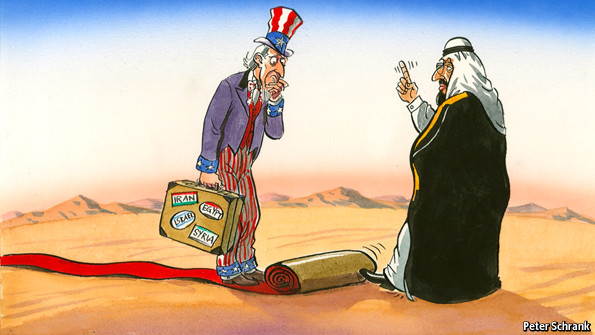
The U.S. relationship with Saudi Arabia has been strained by generations of presidents who have sought to balance fundamental economic interests and raw power calculations with a fundamental distaste for the autocratic, and frequently repressive, regime.

Image Source: Economist
The Economist summarizes the interests at play in this relationship:

“The equation was simple: America would provide security, the Saudis oil. Those shared interests, cemented by a mutual loathing of communism (and a more recently shared hatred of Iran’s Shia theocracy and of al-Qaeda terrorists), papered over inevitable differences between a hermetic autocracy, backed by fearsomely puritanical Wahhabist clerics, and an ebullient, proselytising democracy…In the midst of turmoil across the region, and with the threat of jihadist terrorism ever-present, America still relies heavily on the Saudis as the leading local policeman.”[11]

Saudi disregard for international human rights norms is increasingly forcing the U.S. to pit value based interests of promoting democracy and human rights with economic and security interests. Within this context, Keohane and Goldstein might argue that our values should provide the roadmap for defining our goals and ends-means relationship with Saudi Arabia.

Human rights issues will come to a head this month, as the Saudi autocracy prepares to punish Saudi blogger Raif Badawi with the second installment of a total of 1000 lashes, earned for egregiously “insulting Islam,” or perhaps simply insulting powerful Sunni clerics.[12] One wonder’s little why Badawi’s lawyer was then rewarded with 15 years imprisonment for "undermining the regime and officials," ''inciting public opinion" and "insulting the judiciary.”[13]

Even the UN High Commissioner on Human Rights, Arab Muslim Prince Zeid Ra’ad Zeid al-Hussein of Jordan, called the flogging “cruel and unusual punishment” and torture.[14] The U.S. response has been characteristically timid, with the U.S. Secretary of State John Kerry calling for “many avenues of legitimate review for the judgment.”[15]

The Way Forward

Determining which values best suit the U.S. interests will continue to be a challenge, especially when new diplomatic crisis emerge. Mark P. Lagon, writing for The Council on Foreign Relations, concluded that:  “A broad-minded view is that more consistency in promoting human rights would in fact better serve U.S. credibility and national interests. Presidencies past too often sacrificed human rights for other foreign policy objectives.”[16]


[1] Goldstein, Judith, and Robert O. Keohane. "Ideas and foreign policy: an analytical framework." Ideas and foreign policy: Beliefs, institutions, and political change (1993):  1
[2] Jimmy Carter, Remarks at a White House Meeting Commemorating the 30th Anniversary of the Universal Declaration of Human Rights 's Signing, December 6, 1978 (Accessed online, 21 January 2015 http://www.presidency.ucsb.edu/ws/?pid=30264)
[3] Mark P. Lagon, “Promoting Human Rights: Is U.S. Consistency Desirable or Possible?”, The Council on Foreign Relations, October 2011 (Accessed online, 21 January 2015 http://www.cfr.org/human-rights/promoting-human-rights-us-consistency-desirable-possible/p26228 )
[4] Ibid, par 4
[5] Schmitz, David F., and Vanessa Walker. "Jimmy Carter and the foreign policy of human rights: The development of a post–cold war foreign policy." Diplomatic History 28, no. 1 (2004): 113
[6] Mark P. Lagon, “Promoting Human Rights: Is U.S. Consistency Desirable or Possible?”, The Council on Foreign Relations, October 2011 (Accessed online, 21 January 2015 http://www.cfr.org/human-rights/promoting-human-rights-us-consistency-desirable-possible/p26228 )
[7] Ibid., par 5
[8] Ibid. par 6
[9] McCormick, James. American Foreign Policy and Process. Cengage Learning, 2013, p. 331
[10] President-Elect Barack Obama, Statement of President-elect Obama on Human Rights Day, December 10th, 2008 (Accessed online, 21 January 2015 http://change.gov/newsroom/entry/statement_of_president_elect_obama_on_human_rights_day/)
[11] “Awkward Relations,” The Economist, March 29th, 2014 (Accessed online, 21 January 2015 http://www.economist.com/news/middle-east-and-africa/21599767-american-president-and-saudi-king-will-have-unusually-edgy)
[12] Corey Charlton, “Saudi blogger sentenced to 1,000 lashes,” Daily Mail, 22 January 2015 (Accessed online, 22 January 2015  http://www.dailymail.co.uk/news/article-2921597/Saudi-king-halts-flogging-blogger-facing-1-000-lashes-Middle-Eastern-country-accused-outrageous-inhumanity.html)
[13] Dominique Mosbergen, “Saudi Blogger Sentenced To 1,000 Lashes May Not Withstand 2nd Round Of Flogging, Says Wife,” The Huffington Post, 15 January 2015 (Accessed online, 21 January 2015 http://www.huffingtonpost.com/2015/01/15/raif-badawi-saudi-blogger-flogging_n_6478520.html?cps=gravity_2684_8260730021359095942 )
[14] Rick Gladstone, “Saudi Arabia: U.N. Denounces Flogging of Blogger,” The New York Times, 15 January 2015 (Accessed online, 21 January 2015 http://www.nytimes.com/2015/01/16/world/middleeast/saudi-arabia-un-denounces-flogging-of-blogger.html?_r=0
[15] JAY SOLOMON andnFELICIA SCHWARTZ, “U.S. Rebukes Saudis for Sentencing Blogger to 1,000 Lashes,” Wall Street Journal, http://www.wsj.com/articles/u-s-rebukes-saudis-for-lashing-sentence-1420764258
[16] Mark P. Lagon, “Promoting Human Rights: Is U.S. Consistency Desirable or Possible?”, The Council on Foreign Relations, October 2011 (Accessed online, 21 January 2015 http://www.cfr.org/human-rights/promoting-human-rights-us-consistency-desirable-possible/p26228 )

Marx and Social Media

In their article "Ideas and Symbolic Technologies in International Relations," Mark Laffy and Jutta Weldes introduce the concept of "ideas as capital," drawing on the "ideas as commodities" metaphor they believe is characteristic of the rationalist approach to ideas. The process of labeling ideas as either capital or commodities comes from Marx's "account of the social production of commodities." [1] Laffy and Weldes refer to the Marxist claim that human labor ultimately produces and reproduces social life; that through production, commodities came to govern men's social life.

The process by which social interaction becomes commodity-based is of especial relevance now due to the increasingly important role technology plays in our lives. Back when Marx was writing, the "commodities" he described were tangible things, crafted by men's hands and often essential to their everyday lives. The value of objects was closely linked to the amount of labor they took to make, as well as their ability to satisfy human needs in some way. Yes, mass production and class stratification threatened to alienate men from their labor, but they nonetheless had a close relationship with their labor in the sense that they were actually interacting with objects. And the value of products had some correlation to their concrete usefulness and the effort required to produce them.

Since the 1800s, a new class of workers has emerged, whose work does not require them to engage with tangible products in nearly the same way. Technology has transformed many aspects of Marx's equation: machines are responsible for a great deal of production, consumers are often not required to physically interact with goods before purchasing them, and a whole new Internet-driven market has emerged for the dissemination of both products and ideas.

I would like to focus on a computer programmer as a specific example of the ways in which the notion of "worker" and his/her relationship to labor has changed over the past two centuries. For a programmer working on a website or an app, the majority of his/her work goes unseen by the consumer. Many websites are accessible to the public, meaning there is no limit to who can view it or interact with it.

In Marx's framing, the alienation of a worker from his labor was representative of a power discrepancy between the bourgeoisie and the proletariat. Now, a worker like a tech developer can be in many ways alienated from his labor (not knowing who consumes it, or the uses they may put it to), but he or she nonetheless maintains a kind of ownership over the labor that cannot be taken away.

Where this shallow comparison becomes more complex is in the question of material profit, or capital. A key difference between Marx's worker and the web developer is bargaining power. A web developer working independently might create a popular website and then choose to monetize it by selling advertising space, or simply sell the site to an interested buyer. Even a developer who works within a company has highly valued specialty skills and is likely to be well-compensated. He or she may be alienated from the labor itself, but not alienated from the profits generated thereby. On the other hand, Marx's worker represented a member of the lower class, one whose members became alienated from their labor not by choice, but by economic necessity.

[1] Laffy and Weldes, p. 212.

Goldstein and Keohane Got It Right

My discussion group during class was assigned to discuss the piece by Keohane and Goldstein.  In the other readings for this week, it would seem that the world has to choose between ideas and interests - that a state decision could not be affected by both.  Even further, as discussed in "Ideas and Foreign Policy," both realists and liberal-institutionalists have decided that for states to behave rationally, as they do, that ideas must be secondary to interests.  Keohane and Goldstein, however, reject this assumption and "seek to show that ideas matter to policy, even when human beings behave rationally to achieve their ends."[1]  I believe this is a more accurate version of the way in which individuals and states behave.

Interestingly enough, this concept of individuals achieving a rational outcome is something that I have been learning about this week in my Economics class.  Traditionally in the field of economics, it has been assumed that all human beings are rational and will seek the outcome which will profit them the most.  This is mirrored in the way that Keohane and Goldstein assess the assumption of the realists and the liberal-institutionalists which would assert that the most profitable outcome as determined by the constraints surrounding a state's interests is the only factor that will affect that state's behavior.  Yet, modern economists, much like Keohane and Goldstein, are willing to look at behaviors where one did not choose the greatest output and account for the ideas behind the action, rather than just determine that one is behaving irrationally.

David C. Colander lays out a great example of this in his textbook where he discusses why people are more likely to return cash than a lampshade.  When given the scenario of being given incorrect change by a cashier of $20 extra, 90% of respondents said they would return the extra money.  However, when shopping at the same store, one realized that he or she had not been charged for a $20 lampshade, only 10% claimed that he or she would return to the store to pay for the item that had been left off the bill.  Traditional economists would say that to behave rationally, everyone would keep the money and the lampshade if given the opportunity.  Yet, a very large majority would return the money and keep the lampshade, even though they are of equal value.  For a very long time, this behavior was dismissed as irrational, but recently economists have begun to account for the ideas, or "beliefs held by individuals" as Keohane and Goldstein would define them, and see a common reason and logic in these behaviors.

This phenomenon has been named predictable irrationality in the economic world.  When the respondents of the lampshade scenario were asked why they would return the money and keep the lampshade, a consistent idea of fairness became the common thread.  People have a value or an idea of treating one another fairly, and in the case of the incorrect change, people felt that the cashier might be penalized for the shortage in the drawer and this idea was what determined their actions.  With the lampshade, most felt that this would just be counted as missing merchandise from a store and that no individual person would suffer.[2]

In the way that modern economists have been able to account for individuals behaving in a way that may not be rational in a traditionalist sense but is still targeted, deliberate, and consistent behavior, so have Keohane and Goldstein been able to assess the movements of states and allow for the influence of ideas.  Ideas have their place in determining economic movement, individual behavior, and state actions.  While interests may be the most dominant force in many of these situations, Keohane and Goldstein get it right by constructing analyses of the international sphere that accounts for ideas and, by result, their article is the most constructive and complete.

1. Judith Goldstein and Robert Keohane, "Ideas and Foreign Policy, Beliefs, Institutions, and Political Change," Cornell Studies in Political Economy, (1993); 5.
2. David C. Colander, Economics Ninth edition (New York, McGraw-Hill, 2013), 471.

Monday, January 19, 2015

The Intersection of Beliefs and Interests on the International Stage

As we progress from the theories of liberalism and realism to evaluate the actions and behaviors of states, we can retain the inherited model of Rational Self-Interest as the guiding force for states when interacting on the international realm. Modern international relations theorists have sought to explain state behavior by adapting rational self-interest to encompass both ideas and interests.[1]

A simple example of where worldviews impacted a state’s decisions in the international realm is Chinese views of sovereignty and its effects on their diplomatic efforts at the United Nations. China is involved in a protracted sovereignty dispute over the territory of Taiwan, which maintains its own government and diplomatic relations.[2] Judith Goldstein and Robert Keohane argue that there are three types of ideas or beliefs which impact foreign policy: world views, principled beliefs, and causal beliefs.[3] China has the principled belief that state sovereignty is inviolate. This belief has grown to impact many Chinese actions before the UN Security Council, especially as it relates to Taiwan. China vetoed peacekeeping operations in Guatemala in 1997 and Macedonia in 1999, in response to those countries establishing diplomatic relations with Taiwan.[4] In 1999, as the conflict in Kosovo worsened, the western powers called for military action to restore peace. David Bosco writes that “Russian and China were willing to condemn Serb excesses through tough council resolutions, but they refused to explicitly authorize the use of force. Both countries saw the Western push as a dangerous violation of Serbia's sovereignty.”[5] All three of these examples demonstrate that China was willing to accept some instability and conflict in order to maintain its principled belief that state sovereignty is sacred.

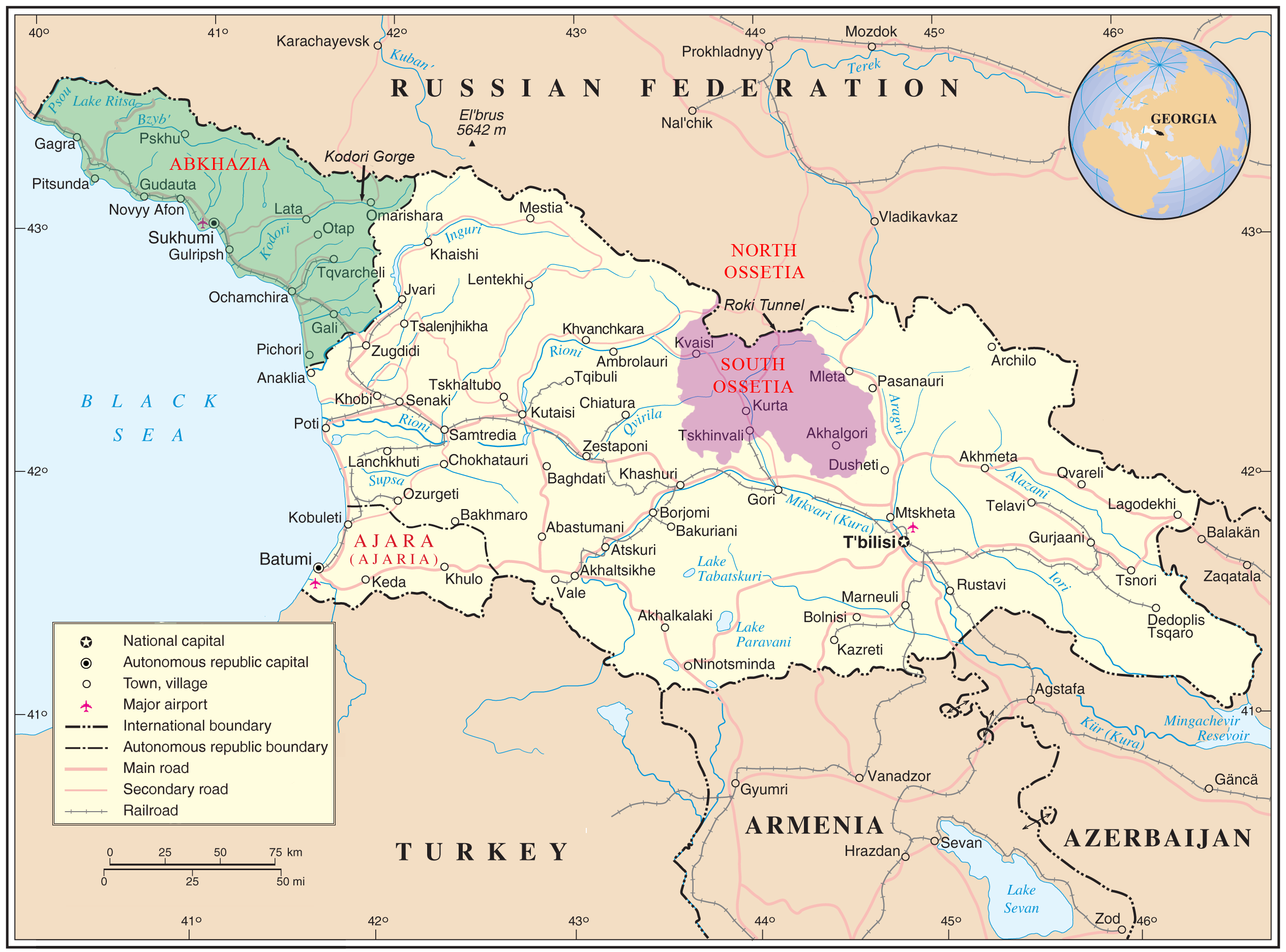
The actions of states when there appears to be a conflict between ideas and interests is an especially important topic of study. The Chinese emphasis on the principle of state sovereignty was tested when Russia invaded Georgia in August 2008.[6] Russia sought to empower separatists in South Ossetia and Abkhazia, effectively annexing territory from Georgia and upending their plan to join NATO, creating a buffer zone between Russia and Eastern Europe.

Image Credit: Wikipedia


China recognized that condemning the Russian incursions on Georgian sovereignty could jeopardize Russian support for any coercive reunification between Taiwan and China. China opted to weaken their stance on national sovereignty rather than condemn Russia’s excesses, offering weak calls for an “Olympic ceasefire” and diplomatic discussions.[7] In this instance, China’s principled belief in national sovereignty was subordinated to its clear interest to have Russian support for Tiawanese reunification.

Image Source: Wall Street Journal

China is increasingly finding it hard to tiptoe the line between supporting sovereignty and condemning their key partner at the UN Security Council. The Diplomat concluded that “China, meanwhile, is trying to tread a fine line on the issue. When asked at a press conference if China would recognize Crimea as part of Russia, Foreign Ministry Spokesperson Hong Lei gave a carefully noncommittal response: “China always respects all countries’ sovereignty, independence and territorial integrity. The Crimean issue should be resolved politically under a framework of law and order. All parties should exercise restraint and refrain from raising the tension.”[8]


[1] Goldstein, Judith, and Robert O. Keohane. "Ideas and foreign policy: an analytical framework." Ideas and foreign policy: Beliefs, institutions, and political change (1993): 5
[2] http://en.wikipedia.org/wiki/Political_status_of_Taiwan
[3] Goldstein, Judith, and Robert O. Keohane. "Ideas and foreign policy: an analytical framework." Ideas and foreign policy: Beliefs, institutions, and political change (1993):10
[4] Bosco, David L. Five to rule them all: the UN Security Council and the making of the modern world. Oxford University Press, 2009. 208
[5] Ibid., 209
[6] http://en.wikipedia.org/wiki/Russo-Georgian_War
[7] Chris Buckley, “China invokes Olympics in urging South Ossetia ceasefire” Reuters, August 8, 2008 (Accessed online January 18, 2015: http://www.reuters.com/article/2008/08/09/us-georgia-ossetia-china-idUSPEK20856020080809)
[8] Shannon Tiezzi, “China Reacts to the Crimea Referendum,” The Diplomat, 18 March 2014 (Accessed online January 18, 2015: http://thediplomat.com/2014/03/china-reacts-to-the-crimea-referendum/