One of the interesting issues that was raised in the class
last night was the sources of legitimacy in the international realm. In an
anarchic international system, there is no coercive force which can claim to
define legitimacy.
States often decide on legitimacy issues by referencing
interpretations of international norms, individual ideas and interests, or following
the demands of their dominant trade partners or allies. As G. John Ikenberry
writes, "leaders and diplomats frequently invoke the notion of
"legitimacy" -- indeed, debate over the recent wars in Kuwait,
Kosovo, Afghanistan, and Iraq was dense with claims and counterclaims about the
legitimacy of military action.”[1]
The line is increasingly blurred by the addition of non-state actors, raising
additional questions of the source and scope of moral and legal legitimacy.
Two case studies are of particular interest:
Sanctions in Iraq

The UN Security Council imposed a “near total financial and
trade embargo” on Iraq, beginning on August 6, 1990, and lasting until May
2003.[2] George
Lopez and David Cortright argue that the sanctions destroyed Iraqi weapons
programs and forced Saddam Hussein to accept nuclear inspectors.[3] The
side effects of the sanctions were shortfalls in food, medicine, and medical
care, which significantly affected the poor and led to a six-fold increase in
the infant and child mortality rate.[4]
The negative effects of these sanctions lead to a heated discussion on the
legitimacy of UN sanctions. The organization Voices in the Wilderness was fined $20,000 for providing medicine and humanitarian aid to Iraq, allegedly violating UN sanctions.[5]
Blockade of Gaza
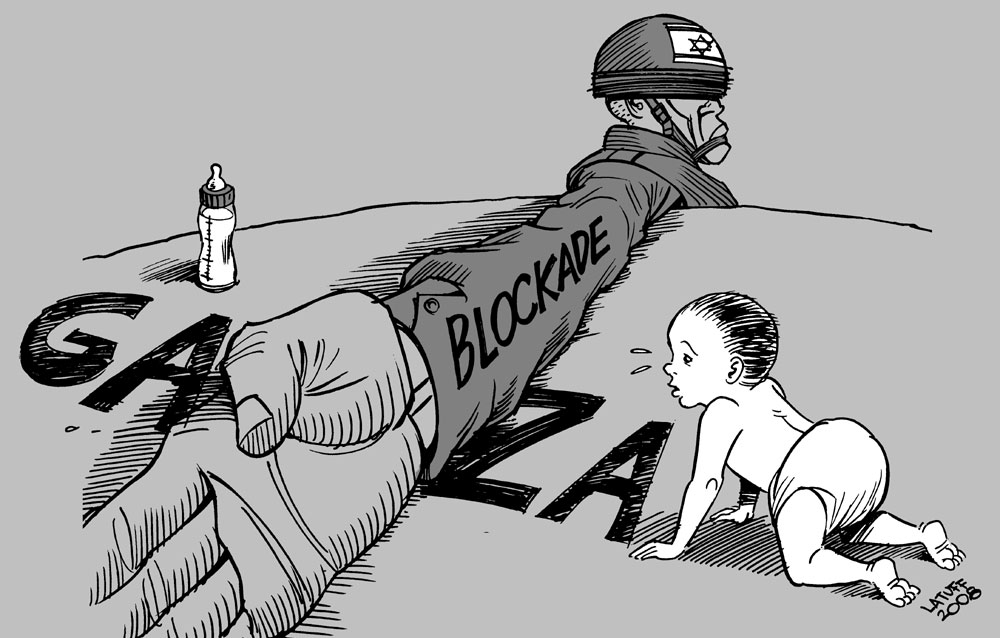
Hamas took power of the Gaza strip in 2007, causing Egypt
and Israel to seal their borders and create a blockade of the area.[6] The
UN Secretary General and the UN Human Rights Council have condemned the
blockade as a violation of human rights. In 2010, Israel raided six civilian
ships in international waters attempting to run the blockade of Gaza, killing
nine activists in the process.[7] The
UN Human Rights Council report determined that Israel’s actions were
illegitimate, that the blockade violated international law, and that the use of
force by Israeli commandos was excessive and unjustified. The U.S. complained
about the wording and Israel cried foul.
Legitimacy plays a key role in evaluating each of these
policy issues. In the case of sanctions in Iraq, the international community
had authorized the policy, but many might fairly argue that it was illegitimate
morally. In the Blockade of Gaza, the international community condemned the
acts, but Israel asserted it was legitimate in using military force to attack
civilian ships in international waters. Powerful states claim that these
situations represent “criminal” acts of the non-state actors, but their claims
to legitimacy are extremely murky, within the context of the anarchic
international system.
[1] G. John Ikenberry, “Legitimacy in
International Society,” Foreign Affairs, October
2005 (Accessed online 03 March 2015, http://www.foreignaffairs.com/articles/60856/g-john-ikenberry/legitimacy-in-international-society)
[2] http://en.wikipedia.org/wiki/Sanctions_against_Iraq
[3]
George A. Lopez and David Cortright, “Containing Iraq: Sanctions Worked,” Foreign Affairs, July/August 2004
[4] “Iraq
Sanctions: Humanitarian Implications and Options for the Future,” Global Policy Forum, August 6, 2002 (Accessed
online 03 March 2015, https://www.globalpolicy.org/component/content/article/170-sanctions/41947-iraq-sanctions.html)
[5] Anderson,
Gary L., and Kathryn G. Herr, eds. Encyclopedia
of activism and social justice. Sage Publications, 2007, p. 1441
[6] http://en.wikipedia.org/wiki/Blockade_of_the_Gaza_Strip
[7] http://en.wikipedia.org/wiki/Gaza_flotilla_raid

Ben- This is great summary of our class debate on legitimacy. You used two very good examples. The Ghaza blockade case reminds me of an earlier case that we actually discussed in our Global Governance class. The case of Israel's wall construction also poses some strong points about the importance of legitimacy in international relations. Thanks for sharing!
ReplyDelete