
Balance of power politics in East Asia is a topic of special
interest within the context of the rise and fall of great powers like the
United States and China. Marc Beeson’s article, “Hegemonic transition in East
Asia? The Dynamics of Chinese and American Power”, offers an interesting
perspective on Chinese foreign policy, stating that “it is clear that China is
not yet – and possibly may never be – in a position to replace the US as the
dominant power in the region.”[1]
Several paragraphs later, Beeson concludes that “despite the apparent
durability of American leadership, its relationship with East Asia generally
and China in particular, suggest that this dominance is declining and may be
less substantial than it appears.”[2]
Traditional power politics would suggest a tug-of-war
relationship between the U.S. and China, with each state seeking to exert its
influence in mutually strategic zones. A cursory analysis of chest-pounding in
the South China Sea seems to reflect this idea. Yan Xuetong, President of the
Carnegie Tsinghua Center for Global Policy, argues that “China and the United
States are vying with each other not only in Southeast Asia but also in many
other parts of the world. The global framework is shifting from being unipolar
to being bipolar, not multipolar. That change derives from an objective shift
in power.”[3]
These power dynamics have led some to refer to the competition between the
United States and China as “the cool war.”
This leads us to a more important question, specifically:
what theoretical framework should be used to characterize great power relations
within the context of international institutions, global governance structures,
non-governmental organizations, and the evolving “global public sphere”?
One such framework is offered by international relations
scholar Joseph S. Nye Jr., in his article “The Future of American Power.” Nye
argues that:
“Power today is distributed in a
pattern that resembles a complex three-dimensional chess game. On the top
chessboard, military power is largely unipolar, and the United States is likely
to retain primacy for quite some time. On the middle chessboard, economic power
has been multipolar for more than a decade, with the United States, Europe,
Japan, and China as the major players and others gaining in importance. The
bottom chessboard is the realm of transnational relations. It includes nonstate
actors as diverse as bankers who electronically transfer funds, terrorists who
traffic weapons, hackers who threaten cybersecurity, and challenges such as
pandemics and climate change. On this bottom board, power is widely diffused,
and it makes no sense to speak of unipolarity, multipolarity, or hegemony.”[4]
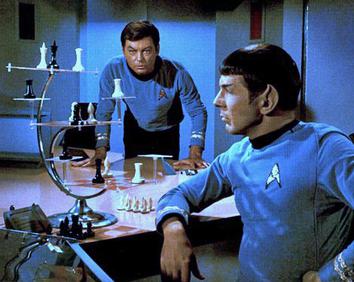
The implications of this view are significant and far
reaching:
The economic and social connections between the U.S. and
China on secondary and tertiary “power chessboards” prevent an armed conflict,
because both countries recognize it would have drastic and far reaching
negative consequences. Yan Xuetong concurs, noting that “recent talk of a “new
type of great power relationship” between the United States and China is based
on implementing control to avoid military conflict.”[5]

The increasingly global nature of security, economics, and
politics also forces the U.S. and China to work together on key issues. Bonnie
S. Glaser, Senior Advisor for Asia, Center for Strategic and International
Studies at the Council on Foreign
Relations, writes that: “The United States has an abiding interest in
preserving stability in the U.S.-China relationship so that it can continue to
secure Beijing's cooperation on an expanding list of regional and global issues
and more tightly integrate China into the prevailing international system.”[6]
China holds over one trillion dollars in U.S. debt, and the U.S. is the most
significant market for Chinese exports, tying their economic fates in a Gordian
knot.[7]
This returns us to the topic of the rise and fall of great
powers. Within the context discussed above, one might argue that we have
abandoned the model of bipolar relations, and that new power relations with
linked interests dominate competition in East Asia. The “Cool War” describes this paradox between
competition and cooperation. Noah Feldman writes in Foreign Policy that “a classic struggle for power between two
countries is unfolding at the same time that economic cooperation between them
is becoming deeper and more fundamental.”[8] The
implications of this relationship are numerous and far reaching, and in many
cases, still undefined.
[1] Beeson,
Mark. "Hegemonic transition in East Asia? The dynamics of Chinese and
American power." Review of International Studies 35, no. 01 (2009):
95-112.
[2]
Ibid., 112
[3] Yan
Xuetong and Koichi Furuya, “Conflict Control” is Key to U.S.-China Relations in
a Bipolar World”, The Carnegie Tsinghua
Center for Global Policy, 14 May 2014 http://carnegietsinghua.org/publications/?fa=55600
[4] Joseph
S. Nye, “The Future of American Power”, Foreign
Affairs, December 2010
[5] Yan
Xuetong and Koichi Furuya, “Conflict Control” is Key to U.S.-China Relations in
a Bipolar World”, The Carnegie Tsinghua
Center for Global Policy, 14 May 2014 http://carnegietsinghua.org/publications/?fa=55600
[6]
Bonnie S. Glaser, “Armed Clash in the South China Sea: Contingency Planning
Memorandum No. 14,” The Council on
Foreign Relations, April 2012 http://www.cfr.org/world/armed-clash-south-china-sea/p27883
[7] Eswar
Prasad, “The U.S.-China Economic Relationship: Shifts and Twists in the Balance
of Power,” The Brookings Institute, February
25, 2010 http://www.brookings.edu/research/testimony/2010/02/25-us-china-debt-prasad
[8]
Noah Feldman, “The Unstoppable Force vs. the Immovable Object,” Foreign Policy, May 16, 2013

China and the U.S. are certainly in a strange, but (what appears to be a) long term relationship.Today China is among the world’s top military powers. One shouldn't underestimate China and its potential to influence. Now, this influence is not necessarily of bad intentions. China wants to rise and has a right to rise, whether we like it or not. Does China’s rise mean the decline of the United States and/or Western powers and their ideals? If China is a ‘threat’ to world dominance (as many realists perceive), will the US and the West compensate and find new and/or better niches to ensure that they remain at least equals?
ReplyDelete